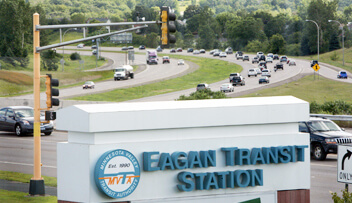

Dakota County is located south of Minneapolis and St. Paul and includes first, second and third ring suburbs and is one of the fastest growing counties in Minnesota. There are 21 cities and 13 rural townships in the county. Fourteen of the cities are suburban, the rest are rural.
2006 Population (Estimate): 391,613
2030 Population (Estimate): 520,010
In 2007, the Dakota County Board adopted six Strategic Initiatives for Economic Development in order to help enhance and coordinate economic conditions at a regional level.
Commercial & Industrial Space Market Study Maxfield Research Inc. completed the Commercial & Industrial Space Market Study in April 2008. It provides demand estimates for commercial/retail, office and industrial space in Dakota County from 2008-2030, as well as for the amount of land needed to accomodate the new space.
The study found that projected household and job growth, among other factors, will create demand for an additional:
10 to 12 million square feet of commercial/retail space
5 to 6 million square feet of office space
6.5 to 7.5 million square feet of industrial space
About 2,200 acres would be needed to accomodate this future need
If you have questions about the Commercial & Industrial Space Market Study, call Andrea Brennan at 651-675-4464.
Property Locator
The 11-county Minneapolis/Saint Paul region consistently ranks among the best places to do business in the United States. To learn more, visit www.MetroMSP.org. This powerful website enables you to locate buildings or land, pull up site-specific demographic data, and generate valuable reports.
Next Generation Broadband
With U.S. internet traffic growth anticipated to increase at least fourteen times over what it is now by 2015, eleven Dakota County cities and the Dakota County CDA have launched an educational campaign about why residents and businesses need to insist on next generation broadband to meet the needs of citizens.
A short video has been created featuring business executives, an emergency manager, a city leader, an educator, a health care expert, and even an Eagan grandmother talking about the benefits that would come from significantly higher broadband than we have today. If more people are able to video conference from home in real time, for instance, that opens up possibilities for consulting medical experts, conducting business meetings from home, accessing online educational classes, and more.
The video points out other societal benefits too. A significant factor in economic development, business location decisions and employment growth is the availability of world class broadband. Next generation broadband could enable so-called smart homes and applicances that monitor their own energy consumption and allow homeowners to cost-effectively make their own decisions about energy use, not to mention have less wear and tear on roadways and lower auto emissions if people telecommute more.
The cities of Apple Valley, Burnsville, Eagan, Farmington, Hastings, Inver Grove Heights, Lakeville, Northfield, Rosemount, South St. Paul, West St. Paul and the Dakota County CDA joined togheter to produce this educational video. It will be shown on local government or public access channels, used for presentations to civic groups and at city council meetings all in an effort to prompt citizens to learn more about the importance of next generation broadband to their future.